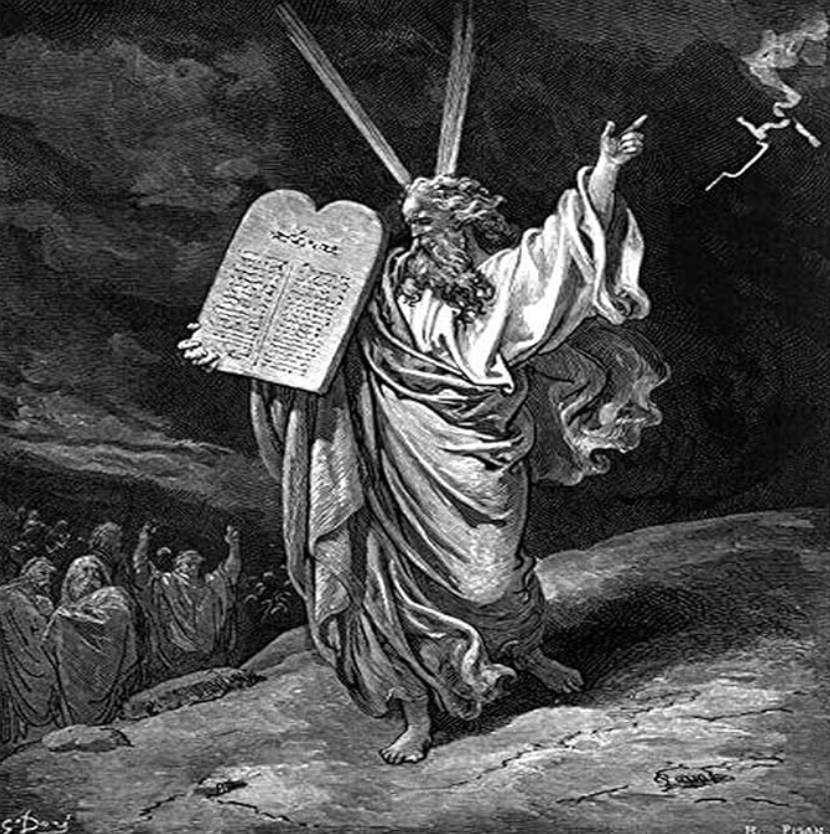
Judges were God’s hand picked regents who enforced the law of Moses and regulated worship practices at the temple which is where God’s physical presence dwelt at its very center. If you read Judges it’s like the Jerry Springer Show meets Game of Thrones… it’s wild, explicit, and no one really has a happy ending. So as Israel eyes all the neighboring pagan empires encroaching on them, the nation goes to Samuel who is one of the only good Judges in this whole epic of their history, and says ‘give us a king to lead us like all the other nations do.’ Here’s 1 Samuel chapter 8:4-9:
So all the elders of Israel gathered together and came to Samuel at Ramah. They said to him, “You are old, and your sons do not follow your ways; now appoint a king to lead us, such as all the other nations have.” But when they said, “Give us a king to lead us,” this displeased Samuel; so he prayed to the Lord. And the Lord told him: “Listen to all that the people are saying to you; it is not you they have rejected, but they have rejected me as their king. As they have done from the day I brought them up out of Egypt until this day, forsaking me and serving other gods, so they are doing to you. Now listen to them; but warn them solemnly and let them know what the king who will reign over them will claim as his rights (NIV).
Imagine Samuel bringing this before God with the tenor of “You’re NOT gonna believe what they want now.” God’s response to Samuel is telling in verse 8, “they have done this from the day I brought them out of Egypt, forsaking me and serving other gods, so they are doing to you.” Keep in mind that’s about a 400 year timeline from the Exodus to this moment in 1 Samuel. I can admittedly feel exasperated with a young toddler after 4 minutes. Could you imagine the exceeding patience of God for 400 years?! God goes on to explicate why this is a really bad idea in chapter 8. The king will take advantage of the people, unreasonably tax them, seize their crops, their herds, and property for his own - that’s just to name a few. So Samuel comes back with this message from God, pleads with Israel, and here’s their response. 1 Samuel 8:19-22:
But the people refused to listen to Samuel. “No!” they said. “We want a king over us. Then we will be like all the other nations, with a king to lead us and to go out before us and fight our battles.” When Samuel heard all that the people said, he repeated it before the Lord. The Lord answered, “Listen to them and give them a king (NIV).
There’s a repeated pattern throughout the Bible of what happens when sin runs so rampant, when it has so thoroughly corrupted a people and repentance is nowhere to be found God hands them over to the consequences of their sins. We read about that in our last series on the pastoral Epistles with Hymenaeus and Alexander being excommunicated from the church in Ephesus (1Tim.1:20) and its happening here. This is not like a tired parent who says, fine, have another cookie if you just leave me alone. Rather God conceding to their wishes is a deliberate choice to give Israel over to their desires… Cool, if it's a king you want, you got it. Israel thinks they just successfully bartered with God, but Samuel made it clear this is only the beginning of their struggles with central leadership. So, in comes Saul, who is the inaugural king in Israel’s brand new monarchy. He’s this burly warrior bro from the tribe of Benjamin that was known for producing strong soldiers (Mackie & Sullivan, 2017). And his reign begins fine after some key military victories that Israel was wanting, but over time the prophecy delivered from Samuel to the nation comes to fruition. Saul begins to disregard Samuel’s prophetic warnings, he directly disobeys God, and then Saul literally goes crazy (1 Sam. 15, 18-19). But in the wings of Saul’s descent into madness is an unassuming shepherd boy named David.
If you flip forward in 1 Samuel to chapter 16, Samuel is told by God to go look for the next king and doesn’t expect David to be the prime candidate. After his arrival to Jesse’s homestead on divine appointment (imagine that knock to your front door and the fed says ‘hey one of your kids is gonna be POTUS’) Samuel examines all the eligible sons for the crown... but God passes over them all. A bit perplexed, Samuel asks Jesse if there are any more sons. Jesse responds with yes, I have the youngest son, he’s out tending the sheep (1 Sam. 16:11). Frankly the English translation doesn’t do enough justice for what is happening here, because the Hebrew word for ‘youngest’ in 1 Samuel 16 verse 11, Ha-katan הקטן doesn't mean youngest in birth order… Ha-katan means unworthy, insignificant, or worthless (Kohlenberger III, 2002).
Jesse is telling Samuel he has an unworthy son, an insignificant son, a worthless son. Imagine if you were introduced by your parents or if you were put in front of a review board for a promotion, or someone submits a character reference for you and it describes you as Ha-katan. It would tear you apart from the inside. You would feel slighted, lack confidence, and be deflated. But here’s where we read something that maybe a lot of you who have grown up in and around Christianity have heard before. 1 Samuel 16:7:
But the Lord said to Samuel, “Do not consider his appearance or his height, for I have rejected him. The Lord does not look at the things people look at. People look at the outward appearance, but the Lord looks at the heart (NIV).
You may think you don’t have anything to contribute to your friend group, to your job, your school, or even to your church. Perhaps you feel bereft of talent and don’t come from any great stock. But here’s good news for you. God’s greatest priority is not the grandeur of your appearance, but the availability of your heart. David’s posture comparatively nimble to that of Saul, but his heart was oriented true north to YHWH. We see this example set in Jesus Himself who called the most ordinary of people to His side as an inner circle and elevated the outcast to royalty in His kingdom - telling blue collared fishermen to drop their nets (Mk.1:16-20) and assuring a Samaritan woman that whoever drinks from Him will never thirst again (Jn 4:13-14). Considering David’s pedigree, there’s a significant moment in Luke’s Gospel that tethers King David to the better and perfect King Jesus.
As Jesus approached Jericho, a blind man was sitting by the roadside begging. When he heard the crowd going by, he asked what was happening. They told him, “Jesus of Nazareth is passing by.” He called out, “Jesus, Son of David, have mercy on me!” Those who led the way rebuked him and told him to be quiet, but he shouted all the more, “Son of David, have mercy on me!” Jesus stopped and ordered the man to be brought to him. When he came near, Jesus asked him, “What do you want me to do for you?” “Lord, I want to see,” he replied. Jesus said to him, “Receive your sight; your faith has healed you.” Immediately he received his sight and followed Jesus, praising God. When all the people saw it, they also praised God (Luke 18:35-43, NIV).
Here is a final reflection from Warren Wiersbe’s commentary that beautifully summarizes Psalm 101 and traces the redemptive threads of David to Jesus Christ.
Was David successful in maintaining the high standard of this declaration? No, not completely; but what leader besides Jesus Christ has ever maintained an unblemished record? David failed in his own family… He had problems with his generals and his trusted counselor betrayed him. But David reigned for 40 years, during which he wrote the psalms and established the dynasty that eventually brought Jesus Christ into the world. Like us, he had his weaknesses and failings, but over all, he sought to honor the Lord and be a good leader. Jerusalem is known as “the city of David” and Jesus as “the son of David.” Could any compliment be higher than that?